
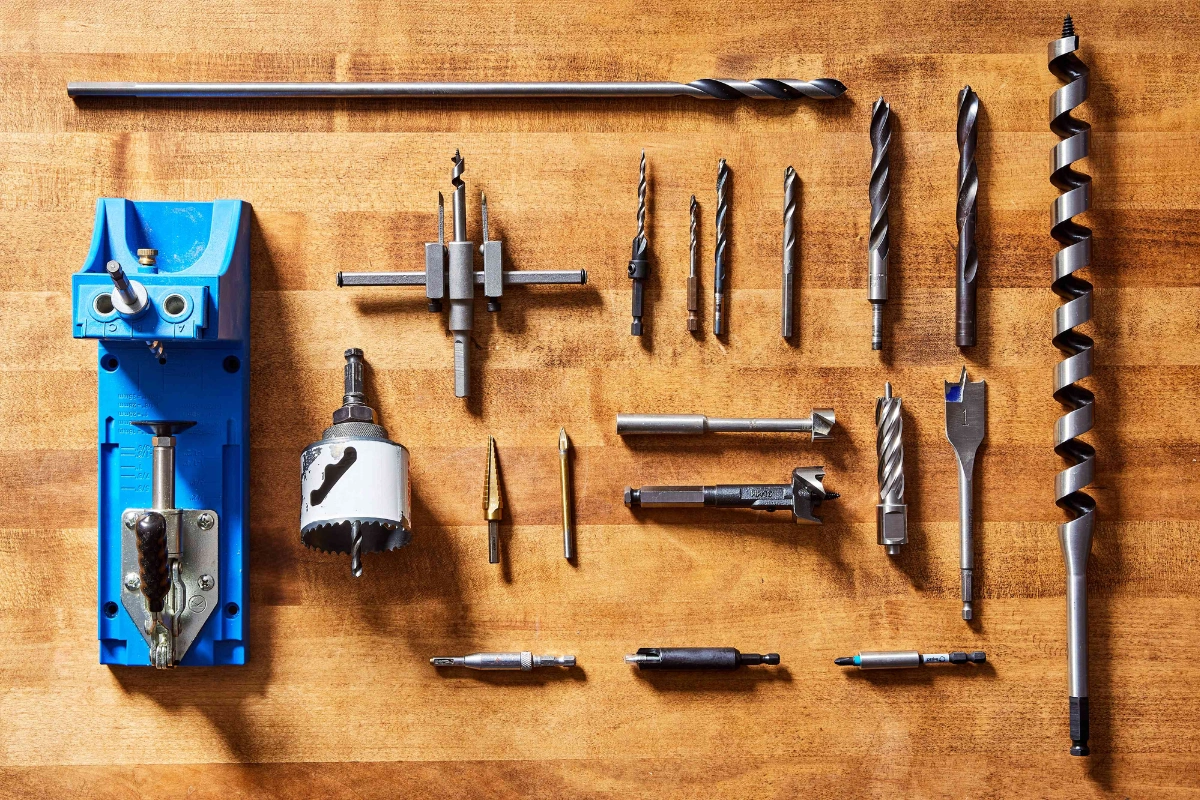
Let’s be real if you’ve ever started a DIY project thinking it’ll take “just a couple of hours,” only to find yourself buried in dust, tangled extension cords, and muttering under your breath you’re not alone. Half the battle in these moments isn’t just the drill itself, it’s knowing which drill bit types to use. And trust me, there are more than a few.
I stood there and asked myself, “Why do I apparently need twelve of these when I’m just putting up a shelf?” and I’ve been there. Every bit has its personality, and every bit has its little superpowers. Pick the right one, and your job feels like butter on warm toast. Pick the wrong one, and well… you might as well be trying to carve granite with a spoon.
So, let’s break it down without the boring jargon.
Why Drill Bit Types Actually Matter
Here’s the truth: not all drill bit types are created equal. Some are designed for wood, others for metal, and some can chew through concrete like it’s a cracker. If you ignore that fact, you’ll either burn out a bit, ruin the material, or, worst-case scenario, crack whatever you were working on. And nobody wants that moment when a simple project turns into a trip back to the hardware store.
When you understand the main wood drill bit types, metal drill bit options, and even the beastly concrete drill bit, your toolbox suddenly becomes way more powerful. Knowledge is the real tool here, isn’t it?
Wood Drill Bit Types – Your Friendliest Allies
Let’s start with the most forgiving material—wood. If you’re dabbling in furniture repair, building shelves, or even trying your hand at a DIY table, you’ll be working with wood.
- Brad-Point Bits: These are probably the most beginner-friendly. They’ve got that sharp little point at the tip that keeps the bit from “wandering” all over your plank. Perfect for precise holes where accuracy actually matters.
- Spade Bits: You’ve seen these—they look like flat paddles. They’re great for larger holes, but they’re not exactly subtle. Think rough-and-ready rather than delicate finishing.
- Auger Bits: If you’re going deep into wood (literally), these are like the corkscrews of the drill world. Great for boring deep, clean holes.
The best drill bit for wood? The answer is I always give-tough. For precision, broad-point all the way. For speed and brute force, spade. And if you want a bit that feels like it’s designed by someone who drinks too much coffee fast and aggressively, grab an auger.
Metal Drill Bit – The Tough Guy of the Group
Metal doesn’t play nice. It’s hard, it’s tough, and if you try to put the wrong bit into it, it’ll just smoke and leave you with a heap of junk. That’s why the metal drill bit is so important.
The go-to here is the high-speed drill bit. The idea behind it is that speedy spinning will keep an edge on an unyielding surface like steel or aluminum. For more stubborn applications, you could even find cobalt or titanium-coated variants. They sound fancy (and they are), but what they really offer is durability. And when you’re drilling into something like a metal pipe, you’ll be grateful for that.
Pro tip? Whenever you drill in metal, you have to use some kind of lubricant. A drop of oil goes a long way in keeping things cool, and it also prevents the bit from dulling too fast. It’s like putting sunscreen on before heading to a beach. You may come to the beach, and do whatever you feel like, but you will really regret it.
Concrete Drill Bit – The Heavyweight Champion
Wood is like a good neighbor, metal is the no-nonsense tough guy, while concrete is Mother Nature’s immovable mountain. Really, though, have you ever tried hanging something on a brick wall and not having the right tools? You’ll dull your bits faster than you can say, “Where’s the hammer drill?”
Enter the concrete drill bit. These are usually tipped with carbide, which is a fancy way of saying they’re tougher than the rest. They’re built to smash through stone, brick, and concrete without crumbling under pressure.
But here’s the kicker: you’ll often need a hammer drill alongside these bits. A regular drill just doesn’t have the “oomph” needed. Pairing a hammer drill with the right concrete bit is like turning on beast mode—it’s noisy, a little aggressive, but it gets the job done.
High-Speed Drill Bit – The Everyday Hero
I have already said it, but it is worth mentioning again on its own. The high-speed drill bit, or HSS bit, if you want to impress your mates, is the bit that you will probably use most often. It can be used on wood, plastic, and softer metals.
It would be like that one trustworthy friend who is always there for everything-move days, late-night calls, and random coffee pickups. It is not flashy but is always there at the time of need.
The Overwhelming Variety – But Do You Need Them All?
Now, when people first discover all these drill bit types, they sometimes panic-buy an entire set of 50 different bits. I get it—it feels safe. But truthfully? Most home projects can be tackled with just a handful:
- A couple of wood drill bit types (brad-point and spade are great starters).
- A solid metal drill bit set.
- At least one sturdy concrete drill bit for those trickier walls.
- And, of course, a high-speed drill bit for everyday jobs.
Anything beyond that? Well, unless you’re building a spaceship in your garage, you’ll probably be fine without it.
Wrapping It Up
Just as at the end of the day drill bit types can be personified in a toolbox, so in the case of everyone with a role, knowing which one to call on when is a secret sauce in making projects smoother. The forgiving wood drill bit types which can drill through clay uptight metals and high-amp concrete drill bits to the stronghold everyday high-speed drill bits-the right tool for any situation. And when you’ve figured that out, you’ll spend less time swearing at your drill and more time actually enjoying the work.
If you’re wondering where to start building your own collection, places like Wickes have a pretty solid range. They also have the best drill bit for wood among many other heavy-duty drill bits for tougher kinds of materials. The next time you look at that DIY project, remember-it’s not just about having a drill. It’s about having the right partner for the job, and that partner is almost always hiding in the right bit.
For more insights on style updates, daily living hacks, and smart product picks, visit TheVougeClub.